Vintage 1986 SVG: A Designer’s Real-World Embroidery Review
First Impressions: Nostalgia That Stitches Well
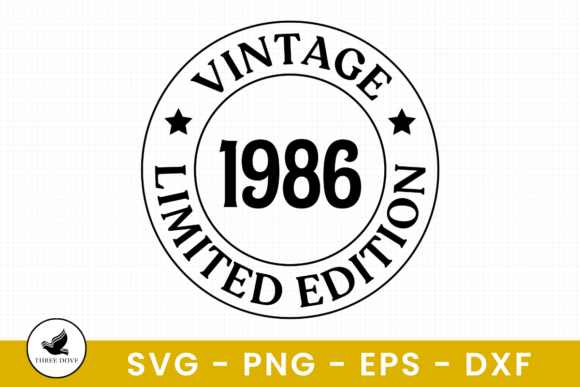
When I opened the Vintage 1986 SVG file for the first time, I wasn’t just scanning for aesthetics—I was mentally hooping it on a cotton tote, picturing how those retro curves and bold numerals would translate in thread. It’s not overly ornate, but it carries weight: clean lines, balanced negative space, and that unmistakable mid-’80s graphic confidence—think school yearbooks, vintage concert tees, and analog camera packaging. The design breathes. That matters more than you’d think when translating flat graphics into raised, textured embroidery.
A Tote Bag Test: Where This Design Earns Its Keep
Last week, I prepped a custom order for a local boutique: ten canvas tote bags celebrating a client’s 40th birthday. I chose Vintage 1986 SVG as the centerpiece—not as a quick Cricut cut, but as a machine embroidery design stitched front-and-center on the left chest panel. Why? Because its layout naturally anchors itself. The “1986” sits low and wide, avoiding awkward vertical compression on curved seams, and the vintage treatment (slight unevenness in stroke weight, subtle serif flair) reads clearly even at 3.5 inches tall. No pixelation, no jagged edges—thanks to the included 300 DPI PNG for mockups and the crisp vector-based SVG for precise digitizing prep.
Where It Shines Across Real Embroidery Projects
- Custom apparel: Works beautifully on crewneck sweatshirts—stitch density stays manageable, and the design doesn’t overwhelm the garment’s texture.
- Tote bag design: Holds up across varied weaves; I used medium tear-away stabilizer and got clean satin stitch borders without puckering.
- Baby embroidery: On organic cotton onesies, I scaled it down to 2.75" and added a soft backing stabilizer—still legible, still charming, no scratchy bulk.
- Embroidered patch: Digitized it with a clean merrow edge and dense fill stitch; looked sharp on denim jackets and craft fair aprons.
- Holiday embroidery & personalized gifts: Paired with a simple “Est. 1986” script below, it became a subtle generational keepsake—ideal for anniversary mugs, tea towels, or nursery wall hangings.
Use With Intention—Not Just Enthusiasm
This isn’t a one-size-fits-all embroidery file. Its charm lies in restraint, so pushing it too far risks losing clarity. Here’s where I pause—and suggest you do too:
- Small hoop sizes (under 4”): The full design fits comfortably in a 5x7 hoop, but trimming it smaller sacrifices legibility in the numeral serifs. Don’t force it into a 3x3 unless you’re willing to simplify manually.
- Textured or stretchy fabric: On slubbed linen or lightweight jersey, use cutaway + topping stabilizer. The open interior spaces in “1986” can sink or distort without support.
- Dark fabric: The design relies on contrast. Test thread colors early—navy thread on black twill muted the vintage feel; switching to cream gave it warmth and authenticity.
- Curved surfaces (caps, beanies): Avoid placing it over the crown seam. It works best on flat panels—front panels of dad caps, side panels of bucket hats, or the center of a pillow cover.
- Frequent-wash items: For kitchen towels or baby bibs, reinforce with a light underlay stitch and avoid ultra-thin fill areas—those fine inner strokes need density to survive laundering.
What It Adds to Your Handmade Product—and Your Reputation
Using Vintage 1986 SVG thoughtfully elevates more than just the item—it reinforces your eye as a designer. Customers notice when typography feels intentional, not slapped on. On Etsy listings, this design consistently performs well in mockups because it reads instantly: “This is a celebration, not just text.” It supports brand consistency for small shops leaning into heritage aesthetics—think bakeries with 1986 founding dates, indie record stores, or family-run hardware shops passing to the next generation. And yes, it builds trust: when a personalized gift arrives with clean, confident stitching, buyers don’t just see a birthday—they see care, craft, and credibility.
Practical Embroidery Designer Notes You’ll Actually Use
- Always test on scrap fabric first—especially if using it for commercial embroidery or client work. Stitch density, thread tension, and stabilizer choice change everything.
- Review the stitch density in your embroidery software. If it’s sparse in the “8” or “6” loops, add a light fill stitch layer to prevent gaps after washing.
- Confirm hoop size compatibility before digitizing or sending to production. The SVG gives flexibility—but your machine’s limits are real.
- Inspect small details at 200% zoom in your design program. Those subtle curve endings? They define the vintage voice.
- Test it in black and white mockups—not just color. Does it retain character on heather grey or charcoal?
- Use proper stabilizer for your fabric type. Medium-weight cutaway for stable knits, tear-away for tightly woven cotton, and fusible + topping for anything delicate.
- Verify licensing before selling finished items or digital products. This is a digital embroidery file—check whether commercial use is permitted for your business model.
Final Thought: A Quietly Confident Design Asset
Vintage 1986 SVG won’t shout. It doesn’t need to. What it does—consistently, reliably—is land with warmth, clarity, and quiet professionalism. It’s the kind of design that makes a baby onesie feel like heirloom quality, turns a plain sweatshirt into a conversation starter, and helps an Etsy seller stand out not with flash, but with thoughtful execution. As a machine embroidery design, it respects the craft: it’s built to stitch cleanly, read well at human scale, and age gracefully—just like the year it honors. For anyone building a craft business, curating handmade product lines, or simply wanting to embroider something that feels *meant* to be worn and kept—that’s where Vintage 1986 SVG earns its place.