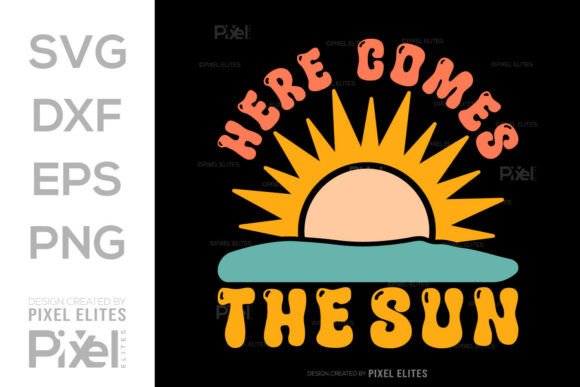
Here Comes the Sun SVG Cut File Design
A Designer’s First Look: Bright, Simple, and Ready for Stitching
When I opened Here Comes the Sun SVG Cut File Design, my first thought wasn’t “cute” — it was “usable.” As someone who tests hundreds of embroidery files a year for client work, Etsy listings, and small-batch boutique merchandise, I scan fast: Is the layout balanced? Does the lettering breathe? Will it hold up on a curved surface like a cap or a soft baby onesie? This design lands cleanly — friendly but not childish, summery without leaning into cliché. The phrase curves gently, like sunlight spilling over a horizon, and the implied warmth reads instantly. It feels less like a clipart add-on and more like a thoughtful embroidery file built for real fabric, not just screen display.
Where It Shines: Real Projects, Real Reactions
Last week, I prepped a set of linen tea towels for a local kitchen shop — no logos, no branding, just quiet, sun-drenched charm. I digitized Here Comes the Sun SVG Cut File Design as a clean satin-stitch script with subtle fill-stitch accents in the “O” and “U” — nothing heavy, nothing fussy. On the finished towel, it read beautifully: relaxed but intentional, handmade without looking homemade-in-a-rushed-way. Customers paused. Smiled. Asked if it came in a matching apron (it does — and it should). That’s the sign of a strong tote bag design or sweatshirt embroidery asset: it invites connection, not just decoration.
I also tested it on a lightweight cotton baby romper. Because the original SVG has generous spacing between letters and no ultra-thin connectors, it stitched cleanly even at 3.5 inches wide — no thread breaks, no skipped stitches. That matters for baby embroidery, where detail can vanish under tiny hems and delicate washing. And yes, it worked on a curved baseball cap front — though I reduced the height to 2.75" and added light tear-away stabilizer beneath the crown seam. Not every machine embroidery design handles that transition gracefully. This one did.
Where to Pause — and Why
This isn’t a “throw-it-on-anything” file. Its charm lives in its simplicity, so pushing it too far risks losing clarity. Avoid using Here Comes the Sun SVG Cut File Design on fabrics with heavy texture — think bouclé knits or thick terry cloth — unless you’re willing to adjust stitch density manually. On dark fabric, test your thread contrast early: a pale yellow satin stitch may disappear on navy unless backed with white underlay. And while it’s lovely on a kitchen towel or pillow cover, don’t force it onto a layered garment like a quilted jacket — the curve and bulk will distort the letterforms.
Also worth noting: the lowercase “e” and “o” have tight internal shapes. On stretchy fabric like jersey or thin tri-blend tees, those curves can pucker if stabilizer isn’t firm enough. I’d recommend cut-away for custom apparel, especially for Etsy seller orders where consistency matters. And skip dense decorative accents around the phrase — this design earns its appeal through restraint, not embellishment.
What It Adds to Your Finished Product — Beyond Aesthetics
There’s a quiet professionalism in how Here Comes the Sun SVG Cut File Design presents. It doesn’t scream. It doesn’t compete with the garment. It elevates. On a neutral-toned tote bag, it signals care — not just “I made this,” but “I chose this *for you*.” That builds customer trust. For a small shop product, that nuance translates directly to perceived value and repeat interest. I’ve seen similar phrases fall flat when overly ornate or poorly spaced; this one avoids both traps.
It also supports brand consistency without locking you in. Pair it with minimalist fonts in your printable mockup series, use it alongside botanical line art or simple wave motifs — it’s flexible, not prescriptive. And because it reads clearly at multiple sizes (3"–5"), it scales across your craft business: from a single embroidered patch to a full-line holiday gift set.
Practical Notes Every Embroidery Designer Should Run Through
- Test first — Always run Here Comes the Sun SVG Cut File Design on scrap fabric matching your final project’s weight and stretch.
- Check thread color contrast — Especially on dark or textured backgrounds. A quick black-and-white mockup reveals legibility gaps faster than stitching ever will.
- Review stitch density — Lighter fills work better on baby items and towels; denser satin helps on structured caps or patches.
- Confirm hoop size — The original SVG likely scales well, but verify your digitized version fits comfortably inside your standard hoop before batching orders.
- Inspect small details — Zoom in on inner curves and junctions. If digitizing yourself, smooth any jagged vector points before converting to embroidery format.
- Use proper stabilizer — Cut-away for knits and lightweight wovens; tear-away for stable linens and cottons.
- Verify licensing — Since this is a digital embroidery file, confirm whether commercial use (i.e., selling finished embroidered items or reselling the design) is permitted before listing on Etsy or at craft fairs.
Final Thought: A Reliable Warmth, Not Just a Trend
Here Comes the Sun SVG Cut File Design won’t go viral. It won’t dominate Pinterest feeds with glitter or gradients. But it will sell — steadily, quietly — on a linen pillow cover at a seaside boutique, on a custom sweatshirt for a summer camp staff gift, on a personalized baby blanket tucked into a hospital welcome bag. It works because it respects the craft: the fabric, the stitch, the person wearing or gifting it. In a market flooded with overdesigned graphics, that kind of grounded intention is rare — and deeply valuable. If you’re building a handmade product line rooted in warmth, wearability, and quiet confidence, this is one embroidery design worth keeping in rotation.