Sewing SVG Bundle
First Impressions: Clean, Friendly, and Ready for Real Stitches
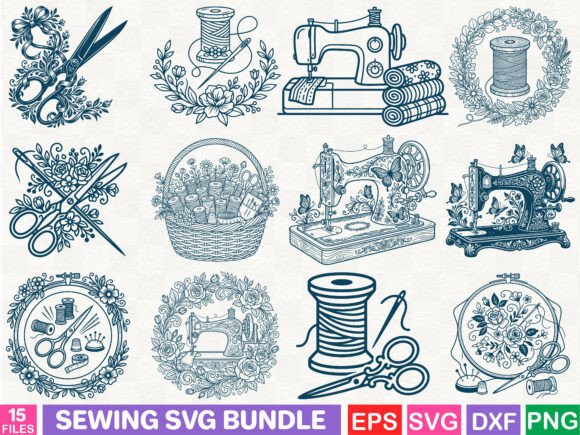
Opening the Sewing SVG Bundle feels like flipping through a well-organized sketchbook—no clutter, no overpromising. It’s clearly built for makers who value clarity over flash. The illustrations carry a warm, hand-drawn charm without sacrificing precision—think soft curves, balanced negative space, and just enough detail to read at 3–4 inches wide. This isn’t a hyper-realistic floral or a dense monogram; it’s a friendly, scalable set of graphics that leans into simplicity and versatility. As an embroidery designer who’s stitched everything from baby onesies to boutique aprons, I immediately saw where this bundle fits: not as a statement piece demanding attention, but as a quiet, confident accent—ideal for custom apparel, personalized gifts, or small shop merchandise that needs to feel handmade, not mass-produced.
A Real Project Test: Embroidering a Linen Tote Bag for a Local Craft Fair
Last week, I pulled out the Sewing SVG Bundle to prep a limited-run batch of linen tote bags for a weekend craft fair. I chose a mid-sized motif—a subtle sewing machine icon paired with a single spool—and resized it to fit cleanly within a 4” x 4” hoop. Right away, the layout worked: generous spacing between elements meant no crowding in satin-stitched outlines or fill-stitch areas. The design translated beautifully into embroidery—not because it’s technically complex, but because its proportions respect stitch behavior. No thin, fragile stems that vanish under thread tension. No tiny interior cutouts that trap lint or distort on textured fabric. On medium-weight linen with tear-away stabilizer, the result was crisp, legible, and quietly professional—exactly the tone my customers expect from a $38 handmade tote.
Where It Shines (and Where It Needs Thought)
The Sewing SVG Bundle performs especially well across common small-business use cases:
- Custom apparel: Works cleanly on sweatshirts and tees when sized 3–5 inches—fill stitches stay open and breathable, and running-stitch accents hold up after washing.
- Baby embroidery: Soft lines and minimal fine detail make it safe for onesies and burp cloths—no risk of stiff, bulky stitching against delicate skin.
- Embroidered patches: Clean edges and moderate stitch density mean it cuts and borders well, especially with heat-seal or sew-on backing.
- Holiday and wedding gifts: Its gentle theme reads as thoughtful—not kitschy—on tea towels, pillow covers, or kitchen linens.
- Etsy listings and digital previews: As Illustrations, these scale cleanly for printable mockups, social media banners, and product thumbnails without pixelation or loss of character.
But—and this matters—Sewing SVG Bundle isn’t universally plug-and-play. On stretchy knits, I’d add light cutaway stabilizer and reduce stitch speed to prevent puckering. On dark fabrics, test thread contrast first: some lighter motifs need richer thread tones to avoid looking washed out. And while it’s lovely on flat surfaces like tote bags or pillow fronts, avoid placing tight clusters of detail directly over curved seams or cap peaks—those areas compress stitch paths and can blur fine lines.
Design Integrity Meets Customer Trust
What stands out isn’t just how the Sewing SVG Bundle looks stitched—it’s how it makes the *finished product* feel. A customer buying a personalized embroidered apron doesn’t just want a logo; they want proof of care, consistency, and intention. This bundle delivers that quietly. Its balanced weight distribution means no heavy anchor points that warp fabric. Its consistent line thickness avoids visual “hot spots” where dense fill stitches might overwhelm. That builds trust—not through loud branding, but through reliability. For Etsy sellers or boutique owners, that translates directly to fewer returns, more repeat buyers, and better photo reviews (“So clean!” “Looks exactly like the listing!”).
Practical Notes Every Embroidery Designer Should Check
Before you load the Sewing SVG Bundle into your machine or list it as part of a digital embroidery file pack, take five minutes to verify these:
- Test on scrap fabric first—especially if using textured, dark, or lightweight materials.
- Review stitch density: Is there enough breathing room between satin-stitched borders and fill areas? Overly dense sections may require reduced density settings or alternate underlay.
- Confirm hoop size compatibility: While scalable, extreme resizing can compromise satin-stitch integrity or running-stitch continuity.
- Inspect small details: Tiny loops, narrow connectors, or fine lettering may need manual cleanup or simplification depending on your machine’s capabilities.
- Check thread color contrast on both light and dark backgrounds—what reads well digitally may disappear under thread.
- Use proper stabilizer: Medium-weight cutaway works best for most apparel; tear-away is fine for stable linens and cottons.
- Verify licensing: Since this is listed as Graphics, confirm whether commercial use—including selling finished embroidered items or bundling as design assets—is permitted before launching products or digital shops.
Final Thought: A Thoughtful Tool, Not a Trendy Gimmick
The Sewing SVG Bundle won’t win awards for complexity—but it doesn’t need to. In real-world embroidery work, reliability, adaptability, and visual calm matter more than flash. It’s the kind of design that supports your brand instead of competing with it. Whether you’re stitching baby embroidery for a new parent, prepping holiday embroidery for your Etsy shop, or building a cohesive line of craft business merchandise, this bundle earns its place in your library—not as a one-off novelty, but as a quietly capable, consistently usable tool. Just remember: even the simplest design deserves thoughtful execution. Test it. Respect the fabric. Honor the stitch. Then let it do what it does best—enhance, not distract.